Uncle Henry Knives

Staglon-handled stockman pocket knives, Bear lockbacks, and the Golden Spike hunting knife. Schrade has made these patterns since the 1960s. Pick by the work you'll do: everyday pocket carry, the deer camp, or the fish table.

4.6 / 5 · 7,500+ reviews
Limited lifetime warranty

Featured Uncle Henry Knives

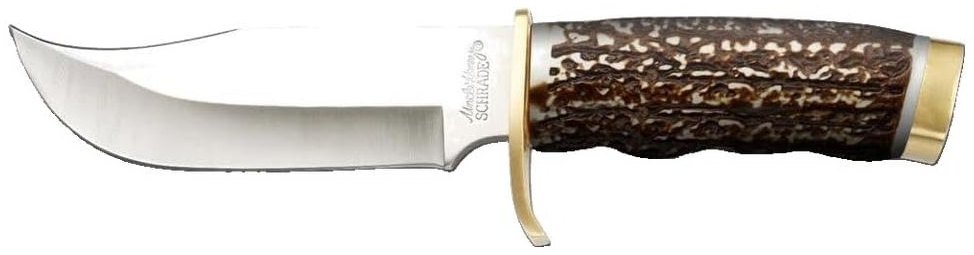
Uncle Henry 153UH Golden Spike fixed blade hunting knife with a Staglon handle and nickel silver guardFixed blade

Uncle Henry 153UH Golden Spike

The best-known Uncle Henry hunting knife

  • 5 in. clip point
  • 9.25 in. overall
  • 6.3 oz
  • 7Cr17 stainless

A fine-pointed clip blade, a nickel silver finger guard, and a Next Gen Staglon handle with finger grooves. The leather belt sheath has a sleeve for the small sharpening stone that comes with it.

Check Price
Uncle Henry 171UH Next Gen Pro Hunter fixed blade knife with an upswept blade, brass guard and Staglon handleFixed blade

Uncle Henry 171UH Pro Hunter

A longer upswept blade for skinning

  • 5.5 in. blade
  • 9.8 in. overall
  • Satin finish
  • Stone included

A hollow-ground blade that sweeps up to the point, made for skinning and camp cutting. It has a brass guard and a Staglon handle, plus a leather sheath with a snap pocket for the included stone.

Check Price
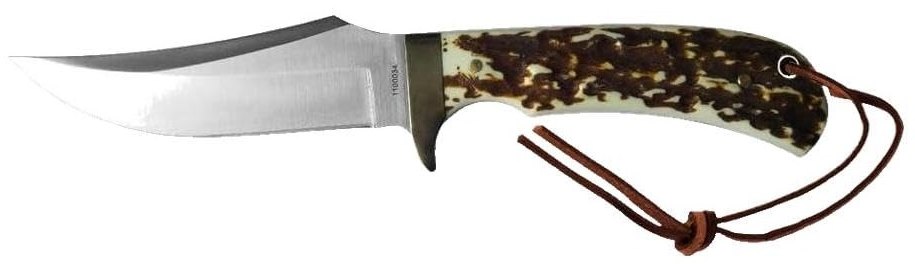
Uncle Henry Elk Horn full tang fixed blade knife with a Staglon handle and leather lanyardFixed blade

Uncle Henry Elk Horn

Full tang, mid-size hunter

  • 4.3 in. blade
  • 8.5 in. overall
  • Full tang
  • 7Cr17MoV

Sized between the Golden Spike and a small skinner. The steel runs the full length of the handle. A finger guard keeps your hand off the edge, and a leather lanyard and leather sheath are included.

Check Price
Uncle Henry 301UH Next Gen full tang skinner knife with a Staglon handle and lanyard holeFixed blade

Uncle Henry 301UH Skinner

Small full tang skinner

  • 3.25 in. blade
  • 6.5 in. overall
  • 2.5 oz
  • Full tang

A short blade with a fine tip for working close to the hide. It weighs 2.5 oz and rides in a leather belt sheath, so you hardly notice it on a long day out. There's a finger choil and a lanyard hole.

Check Price
Uncle Henry 190UH Next Gen Bowie fixed blade knife with a Staglon handleFixed blade

Uncle Henry 190UH Next Gen Bowie

The biggest blade in the lineup

  • About 5.25 in. blade
  • About 10 in. overall
  • 7Cr17 stainless

A Bowie-style blade with more reach than the Golden Spike, a Staglon handle, and a leather sheath. Pick it for bigger camp and outdoor jobs. It isn't meant for small, careful cuts.

Check Price
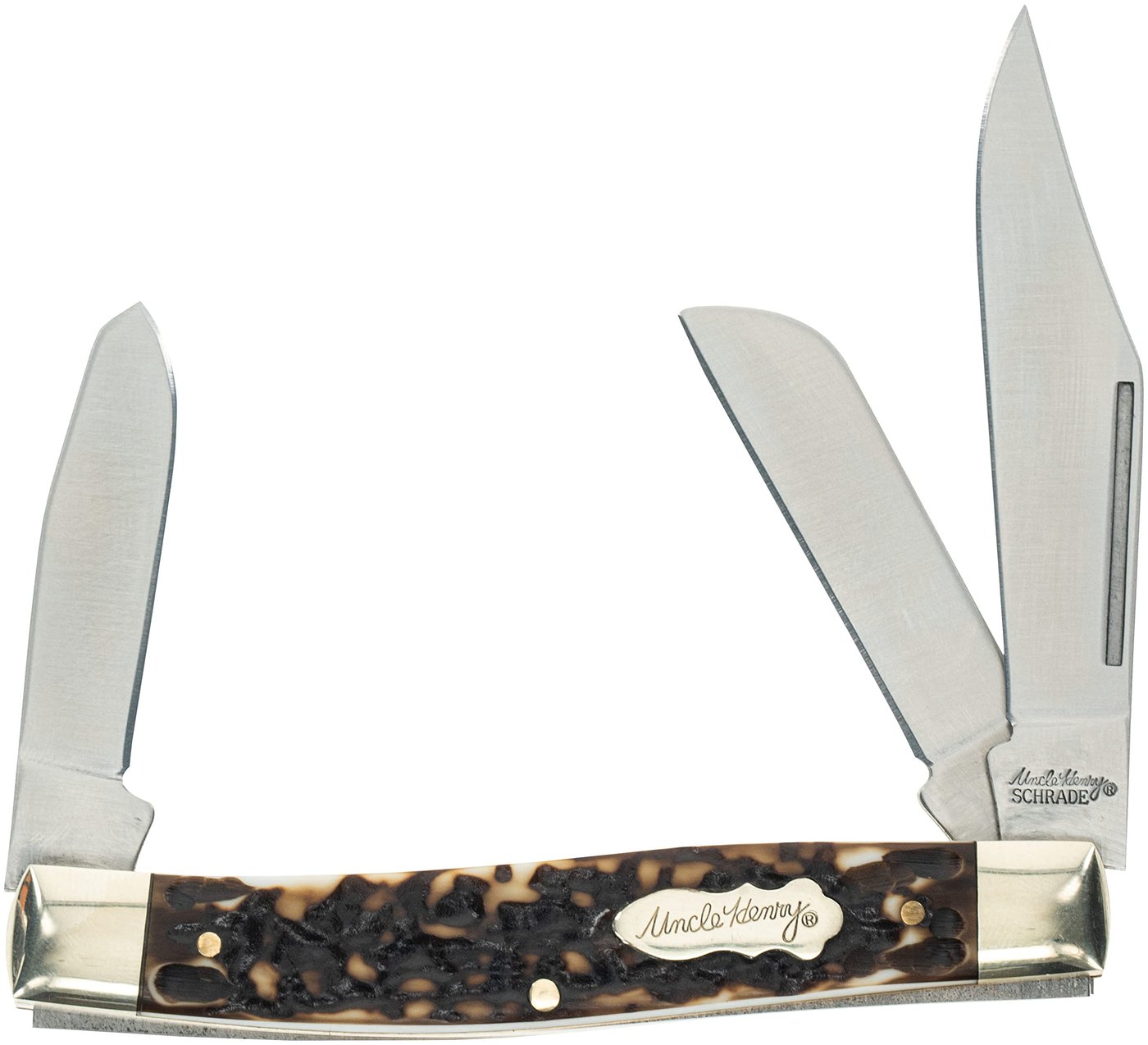
Uncle Henry 885UH Senior Rancher three-blade stockman pocket knife with all blades openPocket knife · 3 blades

Uncle Henry 885UH Senior Rancher

Full-size three-blade stockman

  • About 3.9 in. closed
  • 3 in. clip blade
  • 2.8 oz
  • 7Cr17MoV

Clip, sheepsfoot, and spey blades in one Staglon handle with nickel silver bolsters. Heat-treated back springs hold each blade open and closed. It's a slipjoint, so no lock, and it has a firm snap.

Check Price
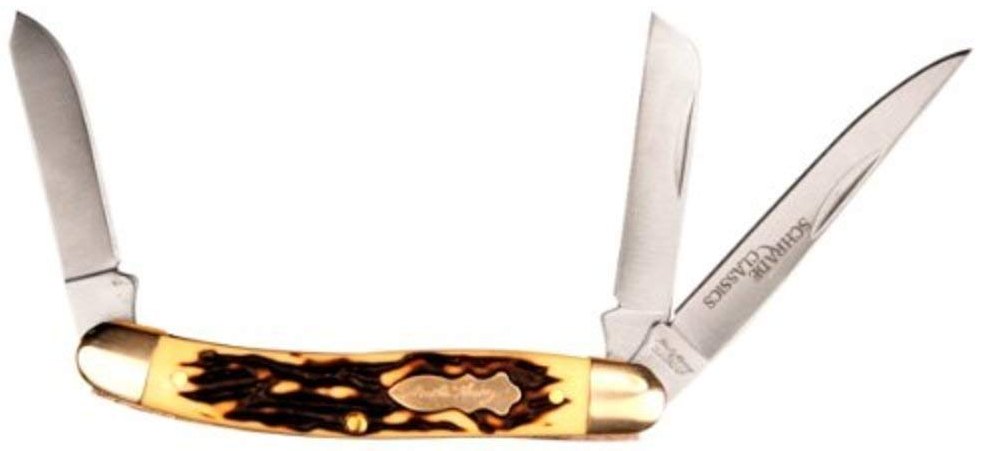
Uncle Henry Signature Premium three-blade stockman pocket knife with Staglon handlePocket knife · 3 blades

Uncle Henry Signature Premium Stockman

Three blades in a smaller frame

  • 3.5 in. closed
  • 2.8 in. main blade
  • 2.1 oz
  • 7Cr17 stainless

The same three-blade layout as the Senior Rancher in a frame that fits a jeans pocket or a work shirt better. It's a good first stockman if you open boxes, trim twine, and cut apples more than you skin game.

Check Price
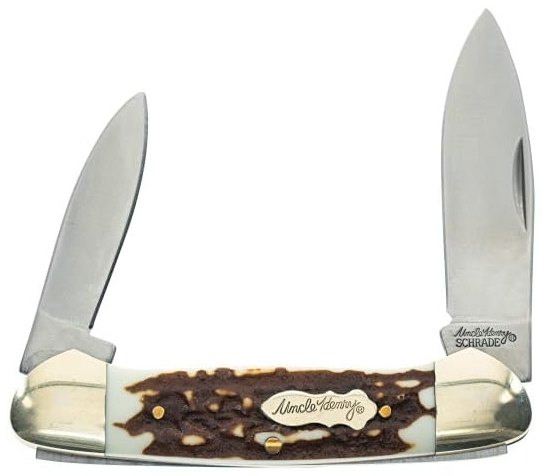
Uncle Henry 11UH Large Canoe two-blade pocket knife with Staglon handle and both blades openPocket knife · 2 blades

Uncle Henry 11UH Large Canoe

Two drop point blades, canoe-shaped handle

  • 2.5 in. blades
  • 6.1 in. overall
  • 2.5 oz
  • Staglon

The canoe is a classic pocket knife pattern with pointed ends and a blade at each one. Both blades here are drop points, which gives you a spare edge for dirty jobs and keeps the other one sharp for clean cuts.

Check Price
Uncle Henry 5UH Bruin folding pocket knife with a drop point blade and Staglon handlePocket knife · 1 blade

Uncle Henry 5UH Bruin

One drop point blade for everyday carry

  • 2.8 in. drop point
  • 6.5 in. open
  • 2.6 oz
  • Staglon

If three blades seem like too much, the Bruin has a single drop point with a wide belly for slicing. The Staglon handle and nickel silver bolster give it the Uncle Henry look at a pocket-friendly 2.6 oz.

Check Price
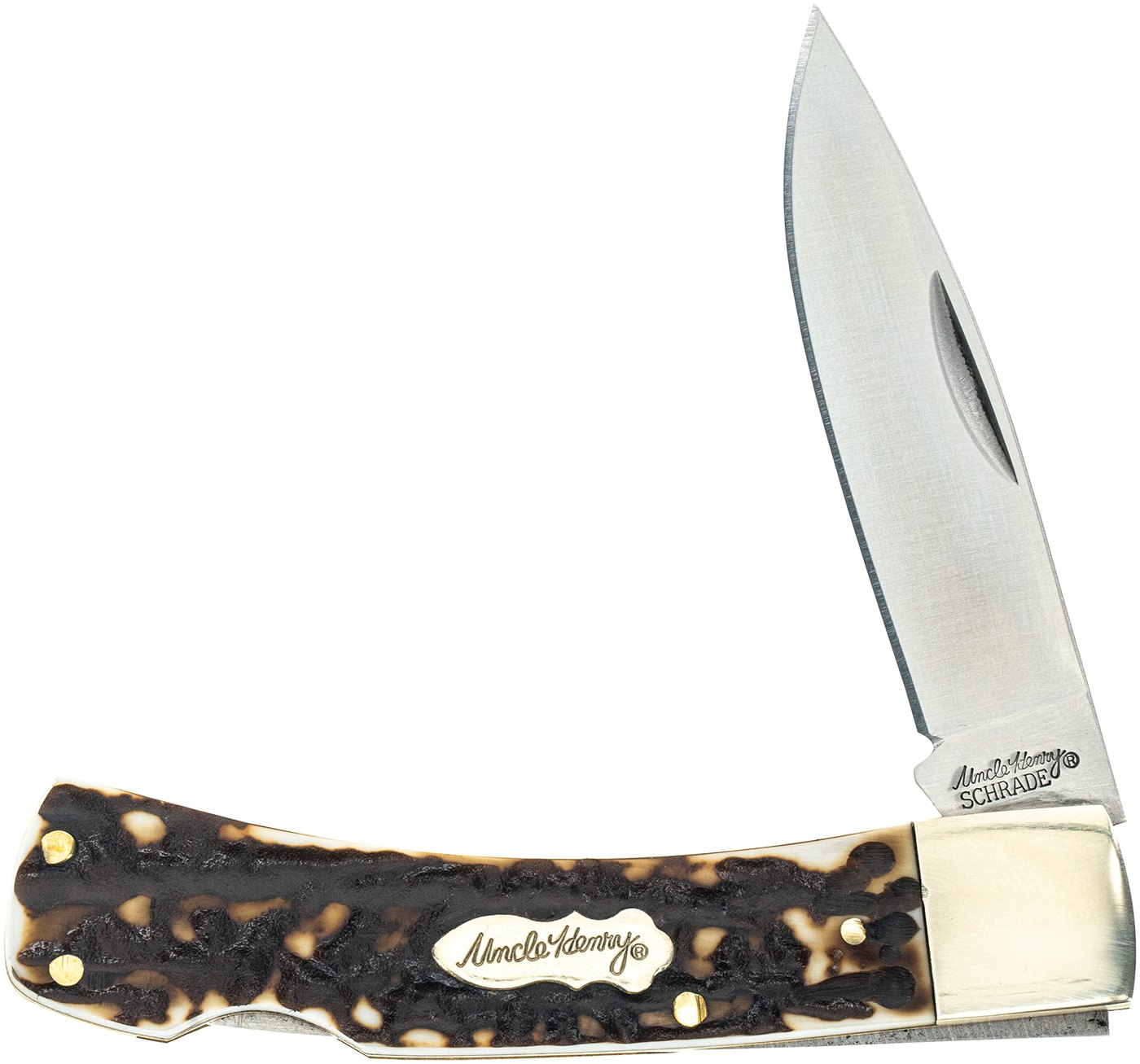
Uncle Henry LB7 Bear Paw lockback folding knife with wood handle and brass bolsters, blade openLockback

Uncle Henry LB7 Bear Paw

Full-size folding hunter

  • 3.7 in. clip point
  • 8.7 in. open
  • Brass bolsters
  • Leather sheath

A big lockback with a wood handle, brass pins, and brass bolsters. It opens with a nail pull and locks open until you press the spine. It's heavy for a pocket, so most owners carry it in the included belt sheath.

Check Price
Uncle Henry LB5 Smokey lockback pocket knife with wood handle and nickel silver bolsters, blade openLockback

Uncle Henry LB5 Smokey

Mid-size lockback

  • 2.8 in. clip point
  • 6.5 in. open
  • 3.1 oz
  • Leather sheath

The Bear Paw design in a size you can carry in a pocket. It has a wood handle, nickel silver bolsters, and a lockback that holds the blade open. A belt sheath comes with it.

Check Price
Uncle Henry LB3 Brown Bear small lockback knife with wood handle and nickel silver bolsters, blade openLockback

Uncle Henry LB3 Brown Bear

Small lockback, 1.6 oz

  • 2.2 in. clip point
  • 5.1 in. open
  • 1.6 oz
  • Wood handle

The smallest of the three Bear lockbacks. It fits a coin pocket and still locks open, which a slipjoint of the same size can't. It handles packages, fishing line, and other light jobs.

Check Price

Which Uncle Henry Knife Should You Get?

  • Carry a pocket knife every daySignature Premium StockmanThree blade shapes, 3.5 in. closed, about 2 oz.
  • Want a full-size stockman885UH Senior RancherClip, sheepsfoot and spey blades in a 3.9 in. frame.
  • Prefer one blade that locks openLB5 SmokeyLockback, 2.8 in. blade, pocket or belt carry.
  • Want a folding hunter on your beltLB7 Bear Paw3.7 in. locking blade and a leather sheath.
  • Field dress deer every season153UH Golden Spike5 in. fixed blade, finger guard, stone in the sheath.
  • Skin more than you split301UH SkinnerShort blade, fine tip, full tang, 2.5 oz.
  • Need more reach around camp190UH BowieAbout 5.25 in. of blade, the longest Uncle Henry here.
  • Clean fishA fillet knifeA thin, flexible blade follows the backbone. A hunter can't.

Blade length isn't everything

A longer blade reaches farther, but a short one is easier to control around joints and hide. For most deer, a 3 to 5 inch blade does the job. If you wear gloves, look at handle size too.

No knife here is a pry bar

Slipjoints can close on your fingers under heavy pressure, and not every fixed blade is full tang. For twisting, chopping, or batoning, use a tool made for it and save the edge for cutting.

What Makes an Uncle Henry Knife

The Uncle Henry look

Staglon handles

Staglon is a molded synthetic made to look like stag antler, in brown and cream. It doesn't crack or dry out like real antler and only needs soap and water. The Next Gen pattern has a deeper texture than older knives, so it grips better when your hands are wet.

7Cr17 and 7Cr17MoV

Stainless steel blades

Current models use 7Cr17 or 7Cr17MoV stainless. It resists rust well and takes an edge easily on an ordinary stone. It won't hold an edge as long as premium steels, but touching it up takes a few minutes. Vintage Schrade+ blades used a different steel.

Clip, sheepsfoot, spey, drop point

Classic blade shapes

A clip point has a fine tip for detail work. A sheepsfoot has a straight edge and a blunt nose, so it slices without poking through. A spey has a rounded tip that won't puncture when skinning. A drop point has a stronger tip for general use. A stockman carries three of these in one handle.

How the blade stays put

Slipjoint, lockback, or fixed

A slipjoint like the 885UH is held by spring tension only, so keep pressure on the back of the blade. A lockback like the LB7 locks open until you press the spine. A fixed blade has no hinge, which makes it the easiest to clean after field dressing.

Are Uncle Henry Knives Made in the USA?

The vintage ones are. Schrade built Uncle Henry knives in Ellenville, New York, until the factory closed in 2004. Today's Next Gen models are made overseas, mostly in China. They keep the old model numbers, patterns, and Staglon look.

That means a listing that says "USA made Uncle Henry" should come with proof. A stag-style handle proves nothing on its own, because the new knives look the same. Ask for clear photos of the tang stamp, the bolsters, and the box if there is one.

On a vintage knife, condition and originality matter more than rarity. Look for an unsharpened factory blade profile, a readable stamp, no blade wobble, and the original sheath. Asking prices vary a lot, so check completed sales of the exact model before you buy.

Reading the tang stamp
  • SCHRADE-WALDEN N.Y. U.S.A.

    Earlier U.S. production

  • SCHRADE+ U.S.A.

    Later U.S. production, before 2004

  • Model number (e.g. 885UH, 153UH)

    Helps match catalogs and variations

  • No U.S.A. mark / China

    Production after the 2004 factory closure

Uncle Henry fillet knives

Uncle Henry has made two fillet knives with Staglon handles and sheaths. The 168UH Small Fillet has a blade of about 5.3 in. for panfish and trout. The 167UH Large Fillet has about 7.5 in. for walleye, bass, and bigger catches. Older USA-made versions, like the 167UH Steelhead, have different specs, so check the listing. Rinse and dry the blade after every trip.

Cleaning and Sharpening Your Knife

1

Clean after use

Wipe the blade off. After food or field dressing, wash with mild soap and warm water. On folders, flush out the pivot and the blade channel so grit and fat don't collect there.

2

Dry it completely

Stainless resists rust but can still spot. That goes double after saltwater. Dry the blade, the bolsters and inside the handle before you put it away.

3

Oil the pivot

A drop of knife oil on the joint keeps blades opening smoothly and the lock catching. Use a food-safe oil if the knife cuts food.

4

Sharpen at 15–20°

Follow the factory bevel, usually 15 to 20 degrees per side. Work until a small burr forms, then use light alternating strokes on a fine stone to remove it. Go gently on thin fillet blades.

Don't store it in the sheath. Leather holds moisture, which can spot even a stainless blade. Keep the knife and sheath apart between seasons. A coat of leather conditioner keeps a new sheath from drying out. Test sharpness by cutting paper, never by running a finger along the edge.

What Uncle Henry Owners Say

4.6 out of 5 from 7,500+ reviews

The Next Gen Pro Hunter arrived very sharp and in excellent condition. It has a very nice grind and an even edge. The Staglon handle is thick and supremely comfortable. The “stag” texture provides great puchase. “Staglon” never has tried to look like real…

Stephen

This knife is made of a tougher kind of stainless steel. Retains a sharp edge. Looks expensive. Durable. The sheath looks cool. Just be careful not to bruise by carelessly inserting the knife in it. Sheath needs TLC to make it look good longer. Classic style…

The Cat

mine

I dubbened the heck out of the sheath and let it soak in for a couple hours..now it’s great.

As for the knife…sharp as the dickens…I love it

Not really meant for chopping wood, or throwing..I did a lot of research so I knew what I was getting.

Long live Uncle Henry

Thanks Schrade

Yours Truely “Uncle Jack”

L

Lightning fast shipping. Beautiful knife for the price! The new mode has the better looking grips which is this model offered for sale. For the price it seems to be very well made and looks great as well. I was hesitant at first but the new stag look is…

jake

The uncle henry 885 in the "new" staglon (a nice looking plastic that imitates antler) is a really nice knife. It is the same size as the old timer 8OT, i.e., a fairly large knife (4" closed) that still fits fine in the pocket. Very good pull and snap, close…

AC

I have been using this knife for years, it was passed down to me from my father and after 20 years of using it I decided to retire it and buy a new one and I'm happy with it. Gifted one of these to a buddy as well and he enjoys it. The blade flexes very well…

gabriel

Who Carries Uncle Henry

Deer Hunters

The Golden Spike and Pro Hunter are made for field dressing. The 301UH skinner works on caping and smaller game.

Everyday Carry

A stockman or the Bruin goes in a pocket for boxes, twine, feed bags, and lunch, then comes out at the end of the day without bulk.

Farm & Ranch

Three blades let you keep one sharp for clean cuts and use another on rope, tape, or dirty jobs.

Anglers

A dedicated fillet knife follows the backbone better than a hunting blade. Rinse and dry it after every trip.

Collectors

Vintage USA-made Schrade knives and today's Next Gen models share pattern names, which makes them fun to compare side by side.

Gift Buyers

A first pocket knife, a groomsman gift, or a replacement for Grandpa's old 885. A classic pattern that will get used.

The Uncle Henry Story

Uncle Henry came out of Schrade, one of the oldest names in American knife making. The line started in the 1960s and was named for Henry Baer, a leading figure at Imperial Schrade. It was meant to be the dressier sibling of the Old Timer line. Where Old Timer had sawcut handles and carbon steel, Uncle Henry had polished stainless blades and stag-style Staglon handles.

For about forty years the knives came out of Schrade's plant in Ellenville, New York. The 885UH Senior Rancher, the LB7 Bear Paw, and the 153UH Golden Spike ended up in countless pockets, tackle boxes, and deer camps. When Imperial Schrade closed in 2004, Taylor Brands bought the name and moved production overseas. In 2016 Smith & Wesson's accessories business bought Taylor Brands. Today Uncle Henry sits under American Outdoor Brands, next to Schrade and Old Timer.

The current Next Gen knives keep the old model numbers and the same patterns: three-blade stockmen, nail-nick lockbacks, and fixed hunters with leather sheaths. The handle texture is deeper and the steel is 7Cr17 or 7Cr17MoV. You still get a traditional knife that works, sharpens on any stone, and lasts decades if you dry it and oil the joint.

Uncle Henry Knives FAQ

Uncle Henry knives are known for traditional American patterns, Staglon handles, and practical blade shapes. Schrade introduced the line in the 1960s, and it became popular for stockman pocket knives, lockback folders, and fixed-blade hunting knives. Well-known models include the 153UH Golden Spike, the 885UH Senior Rancher, and the LB7 Bear Paw. The lineup still sticks to familiar, simple cutting tools rather than complicated mechanisms.

Uncle Henry started as a Schrade knife line, made later under Imperial Schrade. After the original American factory closed in 2004, Taylor Brands bought the trademarks and kept the line in production. Smith & Wesson acquired Taylor Brands in 2016, which brought Uncle Henry into its outdoor accessories business. The brand is now part of the American Outdoor Brands portfolio, along with Schrade and Old Timer.

No. Most modern Uncle Henry knives are made in China. Schrade made them in the United States until 2004. Older American-made knives usually carry SCHRADE+, U.S.A., or SCHRADE-WALDEN on the tang. Modern versions keep the traditional designs but may use different steels and construction. If you want a USA-made Uncle Henry, check the markings and history of that specific knife.

Vintage Uncle Henry knives came from the original Schrade factory in the United States. Current models are made overseas. Older knives often have Schrade+ stainless blades, brass liners, and nickel silver bolsters, while modern ones usually use 7Cr17 or 7Cr17MoV steel. Some model numbers are still in use, but blade sizes, handle construction, and accessories can differ between generations. Original USA-made knives also draw extra interest from collectors.

The 153UH Golden Spike, 885UH Senior Rancher, 897UH Premium Stockman, and LB7 Bear Paw are the best-known designs. The Golden Spike is a fixed-blade hunting knife with a Staglon handle. The Senior Rancher and Premium Stockman each fold three blades into a compact frame. The Bear Paw has a larger locking blade for outdoor work. For fishing, the 167UH Large Fillet and 168UH Small Fillet are the established models.

The 897UH Premium Stockman is a practical everyday carry. It's about 3.5 inches closed, so it stays compact and still gives you three blades. The clip point, sheepsfoot, and spey blades cover different light cutting jobs. The 807UH Junior Stockman takes up even less pocket space. If you'd rather have one locking blade, a compact lockback like the LB5 Smokey or LB3 Brown Bear fits better. Check your local knife laws before carrying any model in public.

Yes. Uncle Henry makes several hunting designs, including the 153UH Golden Spike and large lockback folders like the LB7 Bear Paw. The Golden Spike has a 5-inch fixed blade and a contoured handle for field dressing and general outdoor cutting. A fixed blade is easier to clean after the hunt because there is no pivot to trap blood and fat. The right model depends on the size of the game, the cuts you need to make, and how the grip fits your hand.

It depends on the model and when it was made. Many modern Uncle Henry knives use 7Cr17 or 7Cr17MoV stainless steel, which resists corrosion reasonably well and is easy to sharpen. Older American-made knives usually used Schrade+ stainless. These steels handle routine cutting fine but wear faster than premium modern knife steels. Check the steel on the specific model instead of assuming every Uncle Henry uses the same one.

No. Most classic Uncle Henry knives use Staglon, a molded synthetic made to look like stag antler. Its textured brown and cream look is one of the brand's best-known features. Staglon doesn't need the care real antler does, and every handle has the same consistent grip. Some Uncle Henry models, like the Bear lockbacks, use wood or other synthetics, so check the particular knife.

Both brands came out of Schrade but look different. Uncle Henry is known for stag-style synthetic handles, polished fittings, and stainless blades. Classic Old Timer knives usually have brown sawcut handles, and many vintage ones used carbon steel. Both offer traditional pocket knife patterns and hunting knives. Neither is automatically better at cutting. Blade steel, build quality, and what you'll use it for matter more than the name.

For smaller fish, the 168UH Small Fillet works well because its blade of about 5.3 inches is easier to control in tight spots. The 167UH Large Fillet has a longer blade, about 7.5 inches in later versions, for bigger fish and longer cuts. Both have narrow blades that follow the backbone and lift the fillet off. Flex and dimensions can vary between production runs. Rinse and dry the blade after every trip, especially after saltwater.

Start with the tang stamp near the base of the blade. Older knives usually carry SCHRADE+, U.S.A., SCHRADE-WALDEN, or the model number. Handle construction, blade shape, bolster material, and original packaging can back it up. Schrade made Uncle Henry knives in the U.S. until the original factory closed in 2004. A Staglon handle alone proves nothing, since later overseas versions copy the same look.

It depends on the model, condition, production period, and how original the knife is. Common used pocket knives often sell for a few tens of dollars. Well-preserved examples, uncommon variations, and complete boxed sets can bring a lot more. Original blade finish, readable tang stamps, tight blades, and undamaged handles all raise the value. Completed sales of the exact model give you a far better estimate than asking prices.

Wash the blade with mild soap and water when needed, then dry it fully before storing. Clear debris from the pivot and lock of a folding knife, and add a little knife oil if it feels stiff. Most Uncle Henry blades sharpen on a whetstone or a guided system. About 15 to 20 degrees per side is a good starting point, but follow the existing bevel. Don't store the knife in its leather sheath for long, because leather holds moisture.

Uncle Henry knives have been sold with a limited lifetime warranty against defects in materials and workmanship. Whether a knife qualifies depends on the purchase date, the terms that applied, and original ownership. Published U.S. terms for some products require purchase registration and exclude misuse and normal wear. Vintage knives may fall under older warranty terms. Check the warranty papers that came with your knife for current coverage.

Find Your Uncle Henry

A stockman for the pocket, a Bear lockback for the belt, or the Golden Spike for deer season. See every current model in one place.

Shop Uncle Henry Knives